Blockchain as a Service Platforms Complete Business Guide 2026 SEO BaaS
blockchain as a service platforms for enterprise use caases, costs, security, and scalability to launch faster with less risk.


Blockchain as a service platforms, you’re probably trying to balance speed, cost, and security without building everything from scratch. That’s exactly why BaaS has become the go-to path for enterprises and fast-moving startups alike. Instead of spending months hiring niche engineers, standing up nodes, configuring networks, and maintaining infrastructure, you can use a managed service to deploy blockchain networks, develop smart contracts, and integrate apps with familiar cloud tools.
The result is simple: teams ship real blockchain solutions faster, with fewer operational headaches, and with clearer governance. Whether you’re exploring enterprise blockchain for supply chain traceability, launching a tokenization platform, or building web3 infrastructure for a customer-facing product, the right BaaS approach can turn blockchain from a science project into a measurable business capability.
What Are Blockchain as a Service Platforms?
Blockchain as a service platforms are managed offerings—often provided by cloud vendors or specialist providers—that help you build, deploy, and operate blockchain networks. Think of them as the “cloud hosting + DevOps + security” layer for blockchain, bundled with dashboards, monitoring, key management, templates, and integration tooling.
Instead of running your own validator or peer nodes, managing certificates, tuning performance, and handling upgrades, a BaaS provider automates much of that work. You still control what matters—network permissions, application logic, data access, and governance—but you offload infrastructure operations to a service designed for reliability and scale.
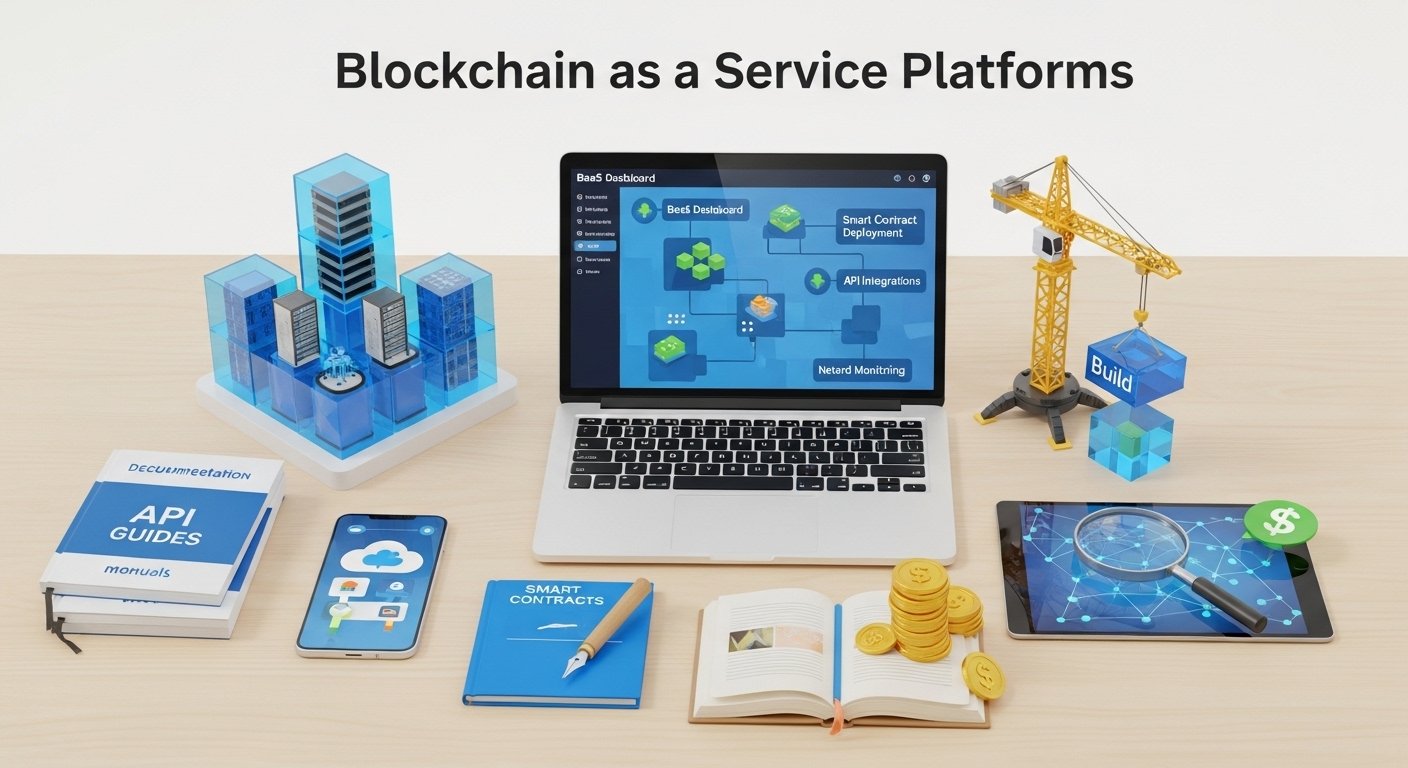
In practice, blockchain as a service platforms typically support one or more frameworks such as Hyperledger Fabric, Ethereum, or other permissioned and consortium-friendly technologies. Many also offer private networking, identity controls, audit logs, and managed databases to help you connect blockchain activity to business workflows.
Why “BaaS” Is Often the Fastest Route to Production
The biggest advantage of blockchain as a service platforms is speed to value. With templates and pre-configured network components, teams can move from proof of concept to pilot much faster. This matters because blockchain initiatives often fail when the timeline stretches and the ROI becomes unclear.
BaaS helps you focus on what differentiates your product: the workflow, the user experience, the token or asset model, and the smart contract development logic. Meanwhile, the provider handles upgrades, node health, scaling, backups, and observability.
Blockchain as a Service Platforms for Enterprise Use Cases
When people search Google for “blockchain as a service platforms,” they’re usually trying to solve practical business problems, not chase buzzwords. Enterprises adopt BaaS when they need shared truth across multiple parties, improved auditability, automation through smart contracts, or better data integrity across complex workflows.
A few of the most searched, first-page-adjacent topics in this space include managed blockchain, enterprise blockchain, blockchain platform, private blockchain, permissioned blockchain, smart contract development, and web3 infrastructure. These phrases matter because they map directly to the decision criteria executives and architects use.
Supply Chain Traceability and Provenance
In supply chain settings, blockchain can store tamper-resistant events, such as handoffs, certifications, and environmental data. Using blockchain as a service platforms simplifies the rollout because you can rapidly onboard partner organizations, set permissions, and standardize reporting. The business benefit is clearer provenance, fewer disputes, and better compliance reporting.
Financial Services, Payments, and Settlement
Banks and payment providers care about audit trails, shared ledgers, and controlled access. BaaS can support consortium networks where participants validate transactions under agreed governance rules. This is where permissioned blockchain capabilities, identity management, and robust monitoring become non-negotiable.
Digital Identity and Credential Verification
Identity solutions often require selective disclosure, verifiable credentials, and privacy controls. While blockchain is not a magic replacement for identity systems, it can be effective for verifiable proofs and shared registries. Many blockchain as a service platforms include integrations for IAM, certificate management, and secure key storage, which reduces risk in identity-heavy deployments.
Tokenization and Real-World Assets
Interest in tokenization platform capabilities keeps rising because businesses want programmable ownership for assets like invoices, loyalty points, or real-world assets. Here, your BaaS selection affects throughput, fees, governance, and interoperability with wallets and compliance tooling.
How Blockchain as a Service Platforms Work Under the Hood
Most blockchain as a service platforms combine four layers: network infrastructure, developer tooling, security and governance controls, and integration services. Understanding these layers helps you compare providers beyond marketing claims.
The network layer includes peer/validator nodes, ordering services (in some frameworks), networking and firewall rules, storage, and backups. The developer layer includes SDKs, APIs, templates, CI/CD hooks, and environment management. The security layer includes HSM or cloud key management, access controls, logging, and policy enforcement. Finally, integration includes event streaming, data export, analytics, and connectors to enterprise systems.
Permissioned vs Public Networks in BaaS
A common misconception is that BaaS is only for private systems. In reality, blockchain as a service platforms can support both private blockchain style deployments and managed access to public networks, depending on the provider.
Permissioned networks are typically favored for enterprise consortia because access is controlled and governance is explicit. Public networks are often chosen for open ecosystems and consumer-facing applications where neutrality and composability matter. Your use case should decide the model, not the other way around.
Key Features to Compare in Blockchain as a Service Platforms
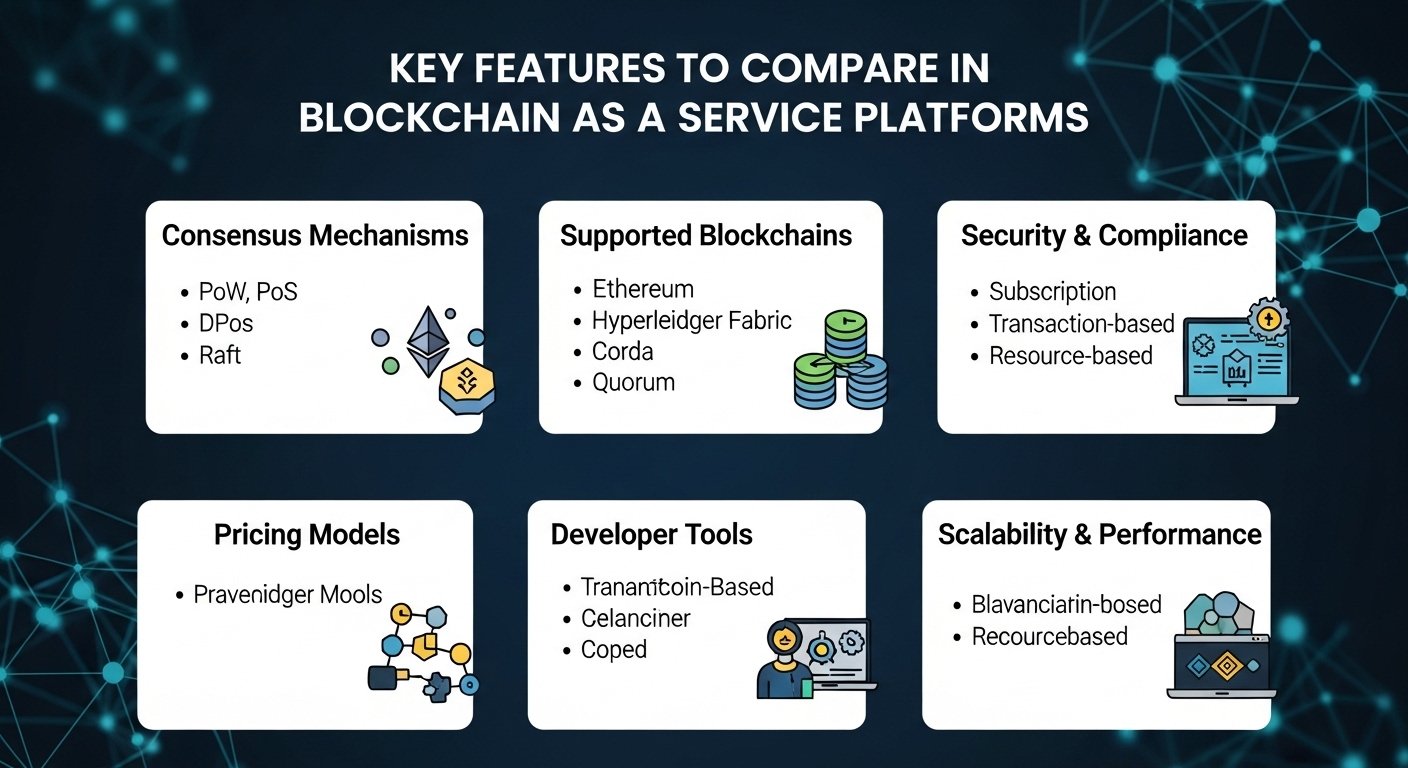
Choosing among blockchain as a service platforms becomes easier when you evaluate them using consistent criteria. You’re not just buying infrastructure; you’re buying reliability, risk reduction, and the ability to evolve.
Security, Compliance, and Key Management
Security is not optional in enterprise blockchain. Look for strong identity integration, role-based access control, secure secret storage, and managed keys with rotation policies. If your industry requires compliance, you’ll also want audit logs, configurable retention, and network-level segmentation.
Scalability, Throughput, and Performance Monitoring
Some applications need high throughput, while others need strong finality guarantees and consistent latency. The best blockchain as a service platforms provide metrics, alerting, dashboards, and tracing so you can understand bottlenecks early. Performance isn’t only about raw TPS; it’s also about predictable behavior under real-world load.
Smart Contract Tooling and Developer Experience
If your developers struggle, your project stalls. Strong BaaS offerings simplify smart contract development with language support, testing frameworks, staging environments, and deployment pipelines. Look for support that matches your stack, plus clear documentation and upgrade paths.
Governance, Consortium Management, and Permissions
If multiple organizations share a network, governance will make or break the system. Many blockchain as a service platforms include tooling for onboarding members, managing certificates, setting channels or subnets, and enforcing policies. Clear governance reduces partner friction and legal ambiguity.
Integration With Existing Systems
Blockchain rarely lives alone. You’ll likely connect it to ERP, CRM, data warehouses, and event systems. Prioritize blockchain solutions that support APIs, event streaming, and data export patterns so your analytics and operations teams can work with blockchain data without painful custom pipelines.
The Real Costs of Blockchain as a Service Platforms
Cost is more than the monthly invoice. With blockchain as a service platforms, you trade some vendor fees for reduced hiring, faster delivery, and fewer operational failures. The “true cost” includes infrastructure, developer time, audits, compliance work, and the cost of downtime.
Infrastructure costs typically scale with node counts, network traffic, storage, and managed services attached to the network. Development costs depend on contract complexity and integrations. Governance costs appear when partners join and when rules change. A good BaaS provider reduces these costs by simplifying upgrades, monitoring, and operational playbooks.
To evaluate ROI, tie the blockchain system to outcomes like fewer disputes, reduced reconciliation time, faster settlement, improved compliance reporting, or better customer trust. If you can’t link outcomes, don’t blame blockchain—tighten the use case.
Best-Fit Scenarios for Blockchain as a Service Platforms
Not every blockchain idea deserves a blockchain. Blockchain as a service platforms shine in specific scenarios where shared truth and multi-party coordination matter. If you have multiple organizations that don’t fully trust each other, but must share a consistent record, blockchain can help. If you need tamper-evident logs that multiple stakeholders can verify, blockchain can help. If you need automation across organizations via smart contracts, blockchain can help. But if one party fully controls the database and trust is not an issue, conventional architectures may be simpler and cheaper.
This is why searches like enterprise blockchain, managed blockchain, and permissioned blockchain often appear alongside “blockchain as a service platforms.” They’re signals that the buyer wants predictable governance and operational control, not just decentralization for its own sake.
How to Select the Right Platform for Your Project
The best way to choose among blockchain as a service platforms is to work backward from requirements, then validate with a structured pilot. Start by defining the participants, the governance model, and the data access rules. Identify what must be on-chain and what should remain in existing databases. Define performance and uptime needs.
Decide whether you require private blockchain controls, or whether a public network better fits your ecosystem. Then evaluate providers based on security, developer tooling, integration options, and operational maturity. A strong pilot doesn’t just show a transaction working. It proves onboarding, permissions, monitoring, incident response, and change management. In other words, it validates that the platform can survive reality.
Conclusion
Blockchain as a service platforms are a practical way to build and run blockchain systems without drowning in infrastructure work. They help teams focus on business logic, governance, and integration, while outsourcing complex operations like node management, upgrades, monitoring, and security hardening.
If your use case involves multiple parties, auditability, automation, or digital asset workflows, choosing the right blockchain as a service platforms can shorten timelines and reduce risk. If you’re ready to move from ideas to implementation, start by defining your governance and integration needs, then pilot with a provider that supports your enterprise blockchain goals, strengthens smart contract development, and fits your long-term architecture. Reach out today and take the next step with blockchain as a service platforms that match your product and compliance requirements.
Frequently Asked Questions
Q: Are blockchain as a service platforms only for big enterprises?
No. While enterprise blockchain adoption is common, blockchain as a service platforms can also help startups move faster. Managed infrastructure reduces the need for specialized hiring and helps small teams reach production sooner, especially when building web3 infrastructure or integrating smart contract development into existing apps.
Q: What is the difference between managed blockchain and BaaS?
People often use managed blockchain and BaaS interchangeably. In practice, managed blockchain usually emphasizes operational hosting and maintenance, while blockchain as a service platforms often include broader tooling for development, monitoring, governance, and integrations. The overlap is significant, so focus on capabilities rather than labels.
Q: Do I need a private blockchain for enterprise use cases?
Not always. Many enterprise projects prefer permissioned blockchain for governance and privacy, but public networks can be right for open ecosystems, consumer-facing products, and composability. The best decision depends on your participants, compliance needs, and long-term growth plan.
Q: How do smart contracts fit into BaaS?
Most blockchain as a service platforms provide tooling to deploy and manage smart contracts, plus logs and monitoring. The quality of the developer experience matters a lot here because contract errors can become expensive and difficult to reverse.
Q: What should I look for if I want to build tokenization?
If you’re building a tokenization platform, evaluate standards support, security of keys and signing, compliance tooling, wallet integrations, and the ability to scale transaction volume. You’ll also want clear governance and upgrade paths, because tokenized systems evolve.