Blockchain Technology Vendor Selection Guide for Enterprises and CIOs!
blockchain technology vendor selection guide to compare vendors, reduce risk, and choose a secure enterprise blockchain partner.

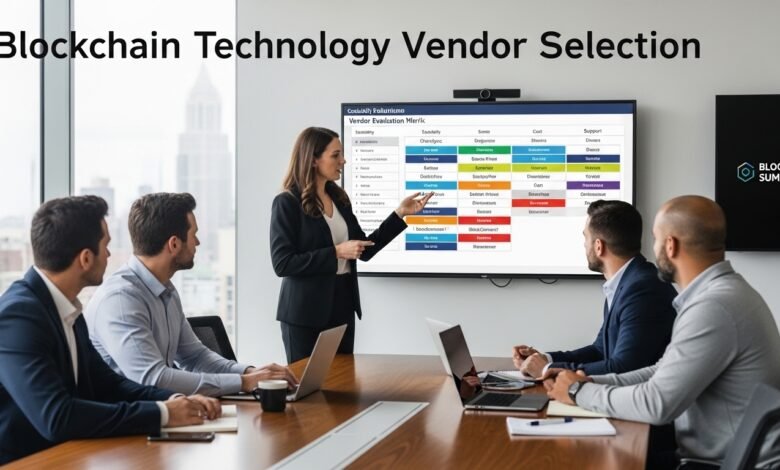
Blockchain technology vendor selection guide, you’ll learn how to choose a vendor that can deliver real outcomes—not just demos. Vendor selection is where most blockchain initiatives either accelerate or stall. Pick the wrong partner and you risk security gaps, compliance headaches, missed deadlines, and a platform that can’t scale beyond a pilot. Pick the right one and you get a clear architecture, reliable delivery, and a roadmap that aligns with your business case. This guide walks you through the decision factors that matter most: use-case fit, platform choice, security and audits, integration, governance, costs, and contract terms—so you can select an enterprise blockchain vendor with confidence.
Blockchain Technology Vendor Selection Guide for Enterprise Buyers
A strong blockchain technology vendor selection guide starts with one truth: “blockchain” is not a single product. You’re choosing a combination of architecture, network model, platform, tooling, and ongoing operations. That means the best blockchain vendor selection process isn’t about picking the most famous name—it’s about matching a vendor’s capabilities to your business constraints.
Enterprises typically buy blockchain in one of these ways: a full-stack blockchain development company that designs and builds the solution; a platform-led vendor that provides a managed network and tooling; or a hybrid partner model where one vendor leads strategy and another leads engineering. Your selection approach should reflect which model you’re buying and how much long-term ownership you want.
Most importantly, treat this like choosing a critical infrastructure partner. A blockchain initiative touches data integrity, identity, security boundaries, legal exposure, and sometimes financial value transfer. The selection criteria should be as rigorous as what you’d use for payments, IAM, or core integration layers.
Define Your Use Case Before You Evaluate Any Blockchain Vendor
Vendors can’t be evaluated fairly until your use case is clear. Many organizations start with a technology-first mindset and then search for a problem. Reverse it. The best blockchain platform selection outcomes come from clear problem framing.
Start by describing the business workflow in plain language: who are the parties, what data is shared, where trust breaks down today, and what outcomes you need. If you’re considering distributed ledger technology (DLT) for supply chain, you might need shared provenance and immutable events. If you’re exploring financial workflows, you may need privacy, identity controls, and settlement finality. If you’re tokenizing assets, you may need custody integrations, regulatory support, and strong blockchain security practices.
A vendor should be able to challenge you respectfully here. If a sales team immediately pushes a chain or framework without clarifying the trust model, data model, and governance, that’s a warning sign. Great vendors ask uncomfortable questions early because they’re trying to prevent expensive rework later.
Decide Whether You Need Public, Private, or Permissioned Blockchain
Your trust model drives everything. Public networks can help when you need open verification and broad participation. Permissioned or consortium models can help when you need privacy, controlled access, and predictable governance. Many enterprise deployments lean toward permissioned blockchain networks because they fit regulatory and confidentiality needs. The vendor you choose should explain tradeoffs without hype: privacy boundaries, node 운영 costs, performance, governance, upgrade strategy, and how participants join and leave the network.
Clarify Success Metrics Beyond “It Works”
A vendor selection process becomes much easier when success is measurable. Define your “win” in terms of time-to-value, reduction in reconciliations, auditability, fraud reduction, settlement speed, compliance improvements, or partner onboarding time. A serious blockchain implementation partner will link design choices directly to those metrics.
Evaluate Technical Fit in Blockchain Platform Selection
Even if you’re mainly hiring a services vendor, the platform choice is still central. Many vendors have a “default” stack. Your job is to confirm that their default matches your reality—or that they can support the right alternative. A mature vendor should be fluent in enterprise-relevant platforms such as Hyperledger Fabric, R3 Corda, and Enterprise Ethereum, and should also be honest about when each is appropriate. They should discuss identity, privacy, consensus, key management, and upgradeability in practical terms, not marketing slogans.
Architecture, Scalability, and Performance Under Real Load
Ask how the vendor tests scalability and what “performance” means in your context. Throughput numbers are often meaningless unless they include your transaction size, endorsement rules, privacy model, and integration overhead. A credible enterprise blockchain vendor will propose a performance test plan that includes baseline measurements, bottleneck analysis, and optimization milestones.
Integration Capability Is Usually the Real Project
Most enterprise blockchain value depends on integration with existing systems: ERP, CRM, IAM, data lakes, payment rails, message buses, and partner APIs. A vendor should show strong blockchain integration skills and talk comfortably about patterns like event-driven architecture, idempotency, reconciliation, and observability. If a vendor focuses only on smart contracts but seems weak on integration, you may end up with an impressive chain that no one can use in production.
Smart Contracts Need Engineering Discipline, Not Just Coding
If your solution includes smart contract development, vendor maturity matters. Smart contracts are business logic with financial and legal consequences. Your vendor should have secure development practices, code review standards, and a plan for upgrades and governance. They should also be able to explain how they prevent common issues like access-control mistakes, reentrancy risks, flawed assumptions about ordering, and poor key management.
Security, Compliance, and Risk Controls You Must Validate
Security is not a feature you add at the end. In blockchain vendor selection, security capability is a core differentiator. A high-quality vendor will discuss threat modeling, secure SDLC, secrets management, identity design, signing policies, and incident response. They should also demonstrate how they handle data privacy concerns, especially when personal data is involved and you must support deletion, minimization, or restricted access.
Demand a Smart Contract Audit Strategy
If smart contracts are in scope, ask how smart contract audit work is handled. Some vendors perform internal audits; others partner with specialized auditors. Either approach can work if it’s structured, documented, and included early enough to matter. A serious vendor will explain how audit findings are triaged, fixed, retested, and documented, and how audit results influence deployment gates. If they treat audits like a checkbox, treat that as a major risk.
Regulatory Compliance and Governance
Enterprises often need clear governance: who can deploy upgrades, who can add participants, what happens in disputes, and how data access is controlled. Your vendor should show how governance is enforced technically and operationally. This is especially critical for cross-company networks where trust is shared but not unlimited.
Vendor Due Diligence—Proof You’re Not Buying a Slide Deck
In a market full of buzzwords, vendor credibility must be verified. Your selection process should require evidence, not promises. A vendor worth considering should provide relevant case studies, architecture references, and delivery artifacts. They should be able to walk you through a similar project’s lifecycle: discovery, PoC, MVP, production hardening, onboarding partners, and operating the network.
Assess the Delivery Team, Not Just the Brand
Many buyers choose a logo and then discover the delivery team is junior or outsourced. Ask who will actually design and build. Validate roles, seniority, and time allocation. Confirm there is a clear technical lead and a security owner. The best blockchain consulting services teams are transparent about staffing and onboarding.
Validate Tooling, DevOps, and Observability
Enterprise-grade delivery requires CI/CD, environment promotion, monitoring, and incident handling. Ask how the vendor manages deployments, key rotation, backups, logs, metrics, and alerting. A vendor who cannot explain operational excellence in detail may leave you with a fragile system.
Commercial Model and Total Cost of Ownership
A project can look affordable upfront and become expensive in operations. Your blockchain technology vendor selection guide should always include TCO thinking. Costs typically include solution design, implementation, audits, cloud infrastructure, node operations, support, upgrades, monitoring, and partner onboarding. On some platforms, transaction fees may matter; in permissioned setups, operational costs dominate. A capable vendor will help you estimate ongoing costs honestly, not only the build cost.
Below is a simple comparison table you can adapt to your evaluation documents.
| Cost Area | What to Confirm with the Vendor | Why It Matters |
|---|---|---|
| Build & Delivery | Scope clarity, change control, acceptance criteria | Prevents budget drift |
| Security & Audits | Audit timing, retesting, remediation ownership | Reduces breach and exploit risk |
| Infrastructure | Node hosting model, scaling approach, backup strategy | Impacts reliability and cost |
| Operations | Monitoring, incident response, SLA support | Determines production stability |
| Governance | Upgrade process, admin controls, onboarding workflow | Prevents network disputes |
Contract Terms That Protect Your Organization
A strong blockchain vendor selection outcome includes strong contract structure. Many blockchain projects fail not only because of technology, but because responsibilities are unclear. Your agreement should define deliverables, acceptance tests, documentation requirements, security obligations, and IP ownership. It should also clarify what happens when requirements evolve, how change requests are priced, and what “done” means.
Make sure your vendor commits to documentation that enables internal ownership: architecture diagrams, threat model summary, runbooks, deployment steps, and a clear upgrade path. If you want to avoid vendor lock-in, require the ability for another team to operate and extend the system later.
Questions to Ask During Blockchain Vendor Selection Interviews
To keep your process structured without relying on checklists, use interview-style prompts that force real answers. Ask the vendor to explain how they would handle your scenario end-to-end, including failure cases and operational realities.

Ask how they choose between Hyperledger Fabric, R3 Corda, and Enterprise Ethereum for enterprise use cases, and what tradeoffs they expect for privacy, performance, and governance. Ask what they do when a partner disputes a transaction event. Ask how upgrades are rolled out without breaking participants. Ask how keys are stored, rotated, and recovered. Ask how they monitor smart contract behavior after deployment.
Listen for specificity. A strong blockchain development company will speak with clear, experience-based detail. A weaker vendor will drift into generic statements like “bank-grade security” or “military-grade encryption” without showing exact practices.
Scoring Vendors Fairly Without Overcomplicating the Process
You don’t need a heavyweight procurement model to choose well, but you do need consistency. Evaluate vendors against the same dimensions: use-case fit, platform suitability, security maturity, integration capability, delivery credibility, operational readiness, and commercial clarity. A practical approach is to define three to five must-haves and a small set of differentiators. Must-haves might include secure SDLC, proven integration experience, and a defined audit strategy. Differentiators might include faster partner onboarding, stronger governance tooling, or deeper domain expertise.
When you compare vendors, weight factors based on your risk profile. If you’re building financial workflows, blockchain security and audit maturity deserve heavier weight. If you’re onboarding many partners, governance and onboarding automation deserve more weight. This is how enterprise blockchain vendor selection becomes rational instead of political.
Common Red Flags in a Blockchain Implementation Partner
Red flags are patterns that repeatedly lead to failed deployments. If a vendor can’t explain how they handle upgrades, key management, monitoring, and audit remediation, assume operational trouble later. If they promise “guaranteed throughput” without load assumptions, assume disappointment. If they push a single platform for every problem, assume platform lock-in.
Also watch for vague ownership boundaries. If it’s unclear who owns cloud infrastructure, who pays for audits, who manages incident response, and who supports the system after launch, you’re buying uncertainty. A reliable blockchain implementation partner clarifies these details early and documents them.
Conclusion
Choosing a blockchain partner is not just a procurement step—it’s a long-term architecture and risk decision. The right vendor will align technology with your business model, design for real-world operations, and prove security and governance maturity from the start. Use this blockchain technology vendor selection guide to evaluate vendors consistently, verify claims with evidence, and prioritize integration and security as first-class requirements.
If you want faster, safer results, apply this blockchain technology vendor selection guide to shortlist vendors, run structured interviews, and demand proof through architecture reviews, audit plans, and delivery artifacts—then move forward with the partner that can carry your solution from MVP to production with confidence.