Bitcoin Market Forecast 2026: Price Trends & Predictions
The bitcoin market forecast 2026, including price predictions, institutional adoption, market trends, and factors shaping Bitcoin’s future.

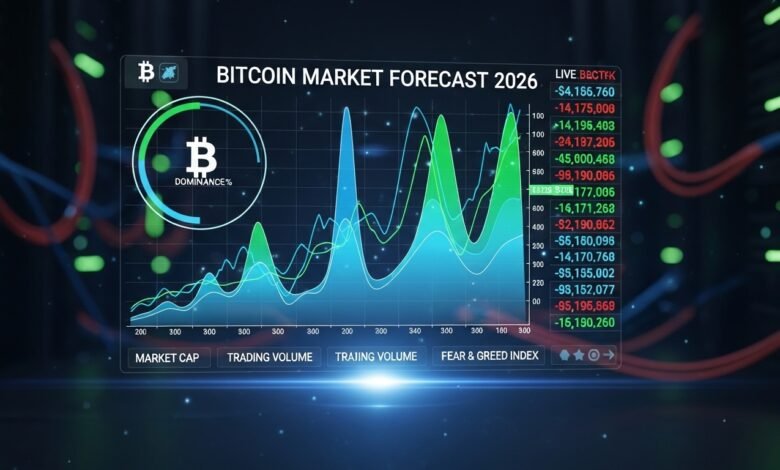
Over the past decade, Bitcoin has evolved from a niche digital experiment into one of the most influential financial assets in the world. Investors, analysts, and institutions are now increasingly focused on the bitcoin market forecast 2026, as the cryptocurrency continues to mature and integrate into global financial systems. With its limited supply, decentralized structure, and increasing institutional participation, Bitcoin is positioned at a critical point that could shape its trajectory for years to come.
The bitcoin market forecast 2026 is driven by several powerful forces, including macroeconomic trends, regulatory developments, technological improvements, and institutional adoption. As global financial markets face uncertainty due to inflation, geopolitical shifts, and evolving digital economies, Bitcoin is often viewed as a potential hedge and long-term store of value.
This article explores the most important factors shaping the bitcoin market forecast 2026, including price predictions, market trends, institutional investment, technological developments, and regulatory challenges. By examining these aspects in detail, investors and enthusiasts can gain a clearer perspective on Bitcoin’s potential trajectory in the coming years.
Bitcoin’s Market Evolution
Before analyzing the bitcoin market forecast 2026, it is essential to understand how Bitcoin’s market has evolved over time. Since its creation in 2009, Bitcoin has experienced several cycles of rapid growth followed by corrections. These cycles are often influenced by macroeconomic conditions, technological advancements, and investor sentiment.
One of the defining characteristics of Bitcoin’s price behavior is its halving cycle. Every four years, the reward given to Bitcoin miners is reduced by half, effectively decreasing the rate at which new Bitcoin enters circulation. This reduction in supply has historically led to significant price increases in the years following a halving event.
The bitcoin market forecast 2026 is closely tied to the impact of the 2024 Bitcoin halving. Historically, the year following a halving has seen substantial bullish momentum, which means that by 2026 the market may still be experiencing the ripple effects of that supply shock.
In addition, Bitcoin’s growing reputation as digital gold, its increasing role in crypto investment portfolios, and its integration into traditional finance have significantly influenced the long-term Bitcoin price outlook.
Key Factors Influencing the Bitcoin Market Forecast 2026

Several critical variables will shape the bitcoin market forecast 2026, ranging from macroeconomic factors to technological innovation.
Global Economic Conditions
Macroeconomic conditions play a major role in the bitcoin market forecast 2026. Inflation concerns, currency instability, and monetary policies from central banks often drive investors toward alternative assets like Bitcoin.
As traditional financial systems face ongoing challenges, Bitcoin’s decentralized structure provides a hedge against currency devaluation. In many economies experiencing inflation or capital controls, Bitcoin adoption has increased significantly.
If global economic uncertainty continues through the next few years, the bitcoin market forecast 2026 could become increasingly bullish as investors search for alternative stores of value.
Institutional Adoption
Institutional adoption has transformed the cryptocurrency market in recent years. Major investment firms, hedge funds, and publicly traded companies have begun allocating portions of their portfolios to Bitcoin.
The bitcoin market forecast 2026 will likely depend heavily on continued institutional participation. Exchange-traded funds (ETFs), institutional custody services, and regulated crypto investment products are making Bitcoin more accessible to large investors.
As financial institutions expand their crypto offerings, Bitcoin could see significant capital inflows. This growing institutional interest strengthens the long-term Bitcoin investment outlook and supports a positive bitcoin market forecast 2026.
Technological Development and Network Upgrades
Technological improvements also influence the bitcoin market forecast 2026. The Bitcoin network continues to evolve through upgrades designed to improve scalability, efficiency, and usability.
The development of the Lightning Network, for example, has enabled faster and cheaper Bitcoin transactions. This layer-two solution allows Bitcoin to function not only as a store of value but also as a practical medium of exchange.
Further innovations could enhance Bitcoin’s adoption in payments, remittances, and decentralized finance applications. These advancements may strengthen the long-term Bitcoin price prediction and positively impact the bitcoin market forecast 2026.
Bitcoin Price Prediction for 2026
The most frequently asked question among investors concerns the bitcoin market forecast 2026 in terms of price. While precise predictions are impossible, many analysts provide estimated ranges based on market cycles, historical patterns, and adoption trends.
Historically, Bitcoin has experienced major bull runs following halving events. The 2016 halving preceded the 2017 bull market, while the 2020 halving was followed by the historic rally in 2021. The 2024 halving could therefore set the stage for another significant cycle leading into the bitcoin market forecast 2026.
Some market analysts believe Bitcoin could trade between $120,000 and $250,000 by 2026 if adoption continues to grow and institutional demand increases. Others offer more conservative estimates, suggesting a range between $80,000 and $150,000 depending on macroeconomic conditions.
Regardless of the exact price point, most forecasts agree that Bitcoin’s long-term trajectory remains upward due to its limited supply and growing global adoption. These factors are central to the overall bitcoin market forecast 2026.
The Role of Institutional Investors in Bitcoin’s Future
Institutional investors are expected to play a defining role in the bitcoin market forecast 2026. Over the past few years, Bitcoin has transitioned from a retail-dominated market to one increasingly influenced by large financial entities.
Asset managers, pension funds, and sovereign wealth funds are beginning to consider Bitcoin as part of their diversification strategies. The availability of regulated investment products has reduced barriers to entry, making it easier for institutions to gain exposure to Bitcoin.
As institutional capital flows into the market, liquidity improves and price volatility may gradually decrease. This maturation of the market could make Bitcoin more attractive to conservative investors, strengthening the bitcoin market forecast 2026.
Additionally, institutional adoption reinforces Bitcoin’s legitimacy as a financial asset. As more corporations and investment firms incorporate Bitcoin into their strategies, the broader cryptocurrency market outlook becomes increasingly optimistic.
Government Regulation and Its Impact
Regulation remains one of the most influential factors in the bitcoin market forecast 2026. Governments around the world are still determining how to regulate digital assets, and their decisions will significantly affect market growth.
Supportive regulatory frameworks could encourage innovation and institutional participation. Clear guidelines on taxation, custody, and compliance may make Bitcoin more accessible to mainstream investors.
However, restrictive regulations could slow adoption and create market uncertainty. Some governments have expressed concerns about financial stability, consumer protection, and illicit activities associated with cryptocurrencies.
The bitcoin market forecast 2026 will therefore depend on how regulators balance innovation with oversight. A collaborative regulatory approach could unlock significant growth opportunities for the crypto industry.
Bitcoin as Digital Gold
One of the strongest narratives shaping the bitcoin market forecast 2026 is Bitcoin’s role as digital gold. Like gold, Bitcoin has a limited supply and cannot be manipulated by central authorities.
This scarcity makes Bitcoin attractive as a store of value, particularly in times of economic uncertainty. Many investors view Bitcoin as a hedge against inflation and currency depreciation.
As global economies continue to experience monetary expansion, the demand for scarce assets may increase. This dynamic strengthens the bitcoin market forecast 2026, especially if Bitcoin continues gaining recognition as a reliable store of value.
Furthermore, younger generations are increasingly comfortable with digital assets, which may accelerate Bitcoin’s adoption as an alternative to traditional stores of wealth.
Bitcoin Adoption Around the World
Global adoption is another critical component of the bitcoin market forecast 2026. In many regions, Bitcoin is becoming more integrated into everyday financial activities.
Developing economies have shown particularly strong adoption rates due to limited access to traditional banking services. Bitcoin offers an alternative financial system that allows individuals to store and transfer value without relying on centralized institutions.
Additionally, cross-border payments represent a major opportunity for Bitcoin adoption. Traditional international transfers can be slow and expensive, whereas Bitcoin transactions can be faster and more efficient.
As global adoption expands, the demand for Bitcoin could increase significantly. This growing usage strengthens the overall bitcoin market forecast 2026 and contributes to long-term market growth.
Potential Risks to the Bitcoin Market Forecast 2026
Despite its strong potential, several risks could affect the bitcoin market forecast 2026.
Market volatility remains one of the most significant challenges. Bitcoin prices can fluctuate dramatically within short periods, which may deter risk-averse investors.
Regulatory uncertainty also poses a risk. Sudden policy changes or restrictions could negatively impact market sentiment and slow adoption.
Technological competition is another factor to consider. While Bitcoin remains the most recognized cryptocurrency, other blockchain networks are continually developing new capabilities.
However, Bitcoin’s first-mover advantage, strong security, and widespread recognition provide it with a significant competitive edge in the cryptocurrency ecosystem.
Long-Term Outlook for Bitcoin Beyond 2026
While this article focuses on the bitcoin market forecast 2026, it is also important to consider the broader long-term outlook for Bitcoin.
Many analysts believe Bitcoin could eventually become a foundational component of the global financial system. As adoption grows and infrastructure improves, Bitcoin may serve as a reserve asset, settlement layer, or alternative monetary system.
The long-term Bitcoin price prediction often extends far beyond 2026, with some projections reaching several hundred thousand dollars per Bitcoin. These predictions depend on continued adoption, technological progress, and favorable regulatory developments. The bitcoin market forecast 2026 therefore represents only one milestone in Bitcoin’s ongoing evolution as a global financial asset.
Conclusion
The bitcoin market forecast 2026 presents a compelling picture of growth, innovation, and transformation within the cryptocurrency industry. Driven by institutional adoption, technological development, and increasing global demand, Bitcoin is likely to remain a dominant force in the digital asset ecosystem.
While challenges such as regulation and market volatility remain, Bitcoin’s core characteristics—decentralization, scarcity, and security—continue to attract investors worldwide. As the cryptocurrency market matures, Bitcoin’s role as digital gold, an investment asset, and a potential financial infrastructure layer may become even more significant.
Although exact price predictions vary, most analysts agree that the bitcoin market forecast 2026 points toward continued expansion and increasing mainstream adoption. Investors who carefully monitor market trends, regulatory developments, and technological advancements will be better positioned to navigate this evolving landscape.