

Finland Homes Get Free Heat From Bitcoin Miners — As Long as BTC Holds Above $70,000
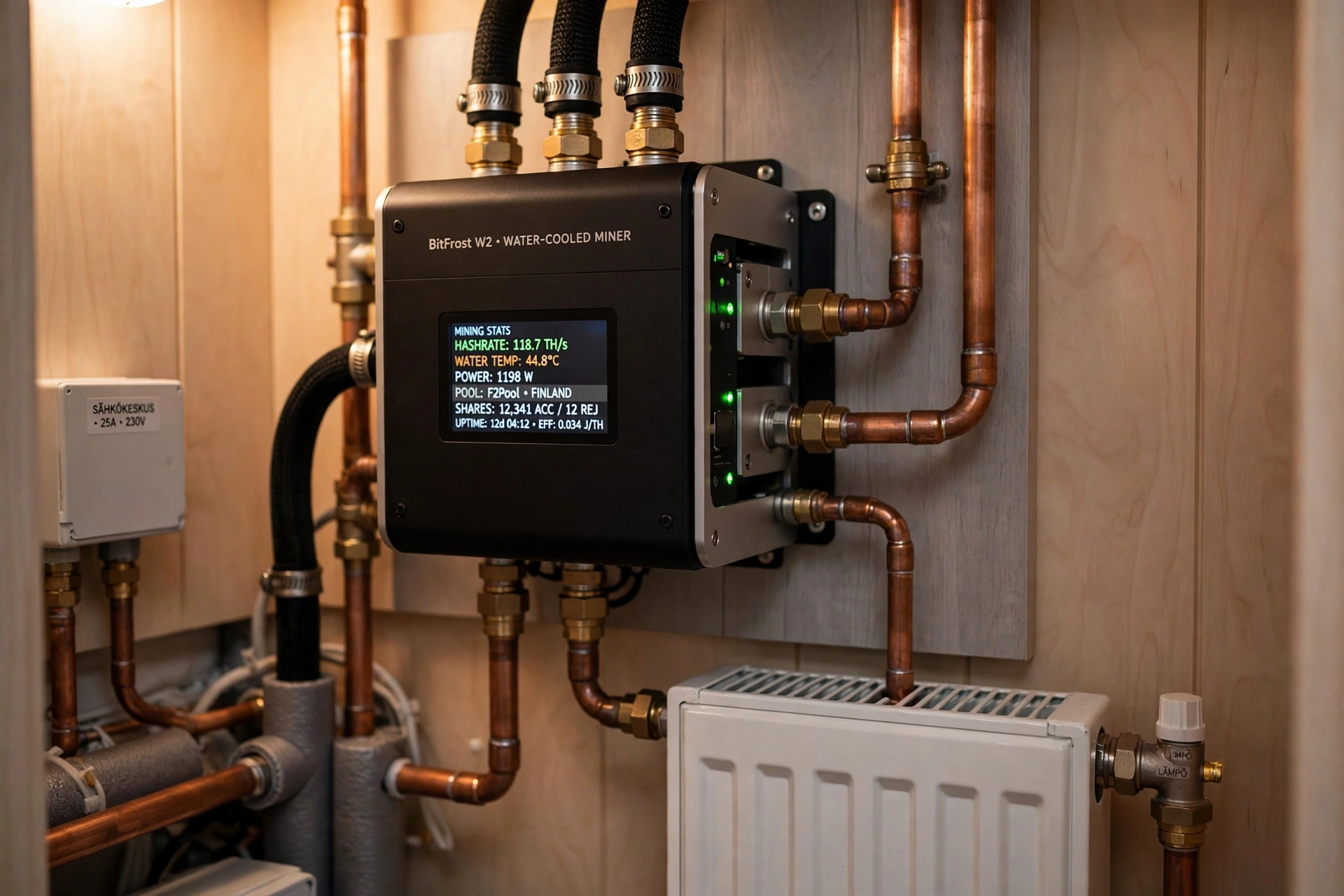
A 180-square-meter house in Nokia, Finland, has fully disconnected from the district heating network and now heats its rooms with a bitcoin miner. The machine sits inside what Finnish company SunBit sells as a Bitcoin Boiler — and while it runs, it earns bitcoin.
Summary
- SunBit has installed 30 Bitcoin Boiler systems, 29 in Finland and one in the Netherlands, that capture mining heat in water at up to 60°C and push it through radiators and floor pipes.
- Every kilowatt-hour a mining computer draws comes out as heat, so if the bitcoin earned covers the electricity bill, the heat is effectively free.
- SunBit puts the break-even at just under $70,000 per bitcoin — the price at which mining income after its fee covers the power bill.
- Systems cost roughly $20,000 or more to install, with SunBit putting payback at three to six years.
- Bitcoin’s next halving, expected in spring 2028, will cut block rewards from 3.125 to 1.5625 BTC — and on SunBit’s own math, the free heat only survives the halving if bitcoin trades above roughly $131,000.
The idea is simple: a mining computer converts essentially all of the electricity it consumes into heat. SunBit captures that heat in water heated to as much as 60 degrees Celsius and circulates it through a building’s radiators and underfloor pipes the same way an oil or gas boiler would, while the machine mines bitcoin the whole time it runs. CoinDesk reported the story on Sunday, November 8.
How the Bitcoin Boiler works
SunBit delivered its first production batch of Bitcoin Boilers in 2025 and now has 30 systems running, founder and CEO Elmeri Suomi told CoinDesk this week. All but one are in Finland, where they have replaced or cut back on gas, oil, wood and district heating.
The installations range from detached homes to a 3,000-square-meter industrial hall. In Kotka, a port city on Finland’s southeast coast, a 200-square-meter house runs one alongside its existing oil boiler as a hybrid system. At an old manor house in Tampere, mining replaced wood heating, and the miner keeps a 1,500-liter water tank at 50°C to 60°C. SunBit’s first export project, a commercial property in Lekkum in the Netherlands, replaced gas heating in 2025.
Unlike a district heating network, the homeowner buys the equipment, pays for the electricity and keeps the bitcoin. The machines sit in a basement or an attached room insulated for sound, since mining rigs are loud.
Finland is already a testbed for heating with mining. MARA’s systems feed waste heat from its miners into district heating networks in Satakunta and Seinäjoki, warming about 80,000 residents. SunBit is bringing the concept closer to the consumer: the property owner owns the machines instead of a mining company.
The math behind the free heat
SunBit’s financial calculator assumes one machine, a 495-terahash variant of Bitmain’s water-cooled Antminer S21 XP Hydro running Braiins OS, third-party firmware SunBit uses to tune its miners. Running nonstop at about 5.3 kilowatts, it uses roughly 46,400 kilowatt-hours a year.
At about 11 cents per kilowatt-hour, that power costs roughly $5,200 a year. SunBit assumes bitcoin at about $82,000 and the network’s total computing power at 1,040 exahashes per second. Under those assumptions, the miner would mine about one-twelfth of a bitcoin a year. After SunBit’s 10% service fee, the owner keeps about $6,100 worth — a surplus of roughly $900 over the modeled electricity bill, before paying for the system itself.
“Mining currently earns slightly more per kWh than the electricity costs, so the heat is essentially a free by-product,” Suomi told CoinDesk.
Bitcoin traded near $81,500 as of U.S. morning hours Friday, according to CoinDesk data. SunBit puts the owner’s break-even — the price at which mining income after its fee just covers the power bill — at just under $70,000, roughly 15% lower. That figure leaves out what the system cost to buy.
One of SunBit’s first customers, who bought a cheaper 358-terahash Antminer S21+ Hydro, has mined about 0.039 bitcoin over the past year, worth roughly $3,160 at current prices, according to a screenshot of the customer’s mining pool account that Suomi shared with CoinDesk. That system replaced about 2,000 liters of heating oil a year.
Heat pumps are a tougher rival
Oil is easy to beat. In a worked example SunBit gave CoinDesk, a detached house burns 2,300 liters of heating oil a year at about $2.19 a liter, a bill of roughly $5,000. Replacing that oil consumption with a miner could theoretically eliminate the fuel bill and, under SunBit’s current assumptions, generate about $920 in mining income after electricity costs — roughly $6,000 a year against SunBit’s quoted installed price of about $20,200, putting payback at about three and a half years before maintenance or financing.
Heat pumps are a harder comparison. They pull warmth from outside air or the ground and deliver 2.5 to 3 kilowatt-hours of heat for every kilowatt-hour of electricity, while a miner turns each kilowatt-hour into exactly one. For a house using 25,000 kilowatt-hours of heat a year, SunBit puts an air-to-water heat pump’s running cost at about $1,100 and district heating at about $3,170.
There is also a catch: more than half of the miner’s heat never reaches the house. A dry cooler outside dumps whatever the house cannot use into the Finnish air, most of it in summer.
Suomi says winter is where a miner pulls ahead. “A miner’s output does not depend on outdoor temperature. Unlike an air-source heat pump, its efficiency does not drop at –25 °C: 100% of the electricity becomes heat at up to 60 °C, every hour of the year,” he said.
The 2028 halving changes the math
Anyone who buys a system now will hit bitcoin’s next halving in 2028 before it pays for itself. The event is scheduled to halve the new coins awarded for each block from 3.125 to 1.5625 bitcoin.
SunBit’s calculator leaves the halving out. It prices payback based on today’s profitability, because the company cannot guarantee future income. “I personally don’t want to give price predictions and difficulty predictions,” Suomi said, adding that SunBit explains the halving to every customer instead, using its past effect on profitability.
Holding SunBit’s own inputs fixed, mining income would drop from about 13 cents per kilowatt-hour to about 7 cents, below the 11-cent power price. A household that installs this winter gets roughly 18 months at today’s margins before the cut. On that math, a miner-heated house in Finland keeps its free heat after the 2028 halving only if bitcoin trades above roughly $131,000, about 60% above Friday’s price.
“The heating itself works regardless of the market, and only the payback time moves,” Suomi said.
Sources: CoinDesk; JBizNews; ProCoinNews