Bitcoin Feb. 13 Daily Chart Alert Big Move Ahead
Bitcoin Feb. 13 daily chart alert arrives at a moment when Bitcoin looks calm on the surface, yet the daily chart suggests something larger

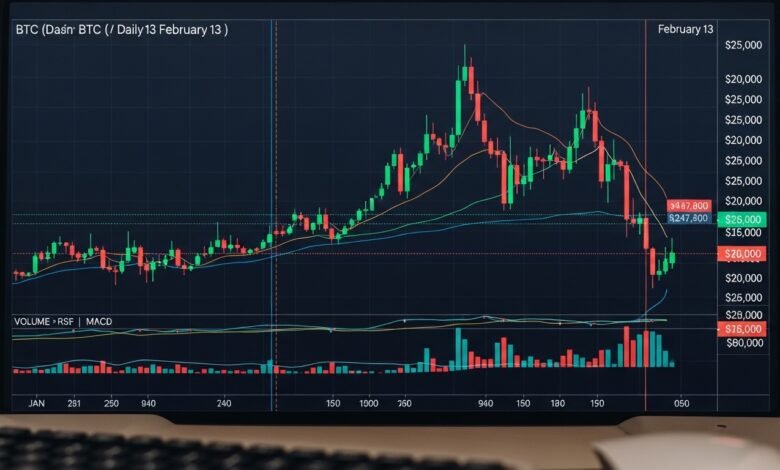
Bitcoin Feb. 13 daily chart alert arrives at a moment when Bitcoin looks calm on the surface, yet the daily chart suggests something larger is building underneath. When price spends multiple sessions compressing into a tighter range, it often means buyers and sellers are reaching a tipping point. That tipping point can produce a sudden expansion in volatility—typically a stronger-than-usual move that catches late traders off guard. In other words, the market may be “quiet,” but it’s not necessarily “safe.”
Right now, many traders are watching the same thing: Bitcoin is holding near a major psychological zone while repeatedly testing nearby support and resistance. The daily candles are showing hesitation, but the structure is also showing pressure. In a typical cycle, this kind of setup tends to precede a decisive move. It could be a bullish breakout that pulls momentum back into the market, or it could be a bearish breakdown that triggers stop losses and liquidations. The purpose of this Bitcoin Feb. 13 daily chart alert is to walk through what the daily timeframe is signaling, which levels matter most, and how to read the next move without getting trapped by hype.
Because this is a daily chart focus, we’re prioritizing clarity over noise. The daily timeframe filters out much of the intraday chaos and highlights the levels and trends that matter most to swing traders, investors, and anyone who wants a cleaner view of market direction. If you’ve been waiting for a higher-confidence setup, the chart is getting closer to a point where it will force an answer.
Bitcoin Feb. 13 daily chart alert: The daily trend context and what it implies
A strong Bitcoin Feb. 13 daily chart alert starts with trend context. Trend context answers a simple question: is Bitcoin currently trending, correcting, or ranging? Over the past several weeks, Bitcoin has shown signs of both strength and instability, moving through swings that attracted both breakout buyers and dip buyers, while also giving sellers multiple opportunities to defend overhead resistance.
On the daily chart, the most important observation is that Bitcoin’s recent candles suggest a pause after a meaningful move. Pauses are not random. They are often where the market reallocates positions. Some traders take profits and exit. Some traders open new positions anticipating a continuation. Others hedge because they’re uncertain. That mix tends to compress price action into a tighter range, and that range becomes the battlefield.
When a range forms after an impulsive move, two outcomes are most common. The first is continuation: the market breaks in the direction of the previous impulse once enough pressure builds. The second is reversal: the market fails to hold key levels and breaks the other way, forcing traders to unwind positions. Either way, the “coiling” action is frequently a precursor to expansion. That’s the central theme of this Bitcoin Feb. 13 daily chart alert—the chart is hinting that a bigger move may be near.
What compression looks like on a Bitcoin daily chart
Compression on the daily chart usually appears as smaller candle bodies, repeated wicks, and price spending more time in a defined zone. It can also show up as “overlapping candles,” where multiple days trade through similar highs and lows. This tells you that neither side is in full control. Bulls can’t push through resistance decisively, and bears can’t break support decisively.
In Bitcoin markets, compression is especially important because the asset is naturally volatile. When volatility drops, it often returns sharply. That return can be amplified by leverage, liquidity gaps, and clustered stop orders above or below obvious levels. A well-timed Bitcoin Feb. 13 daily chart alert pays attention to where traders are likely to be positioned, because that positioning can fuel the next move.
Key levels driving this Bitcoin Feb. 13 daily chart alert
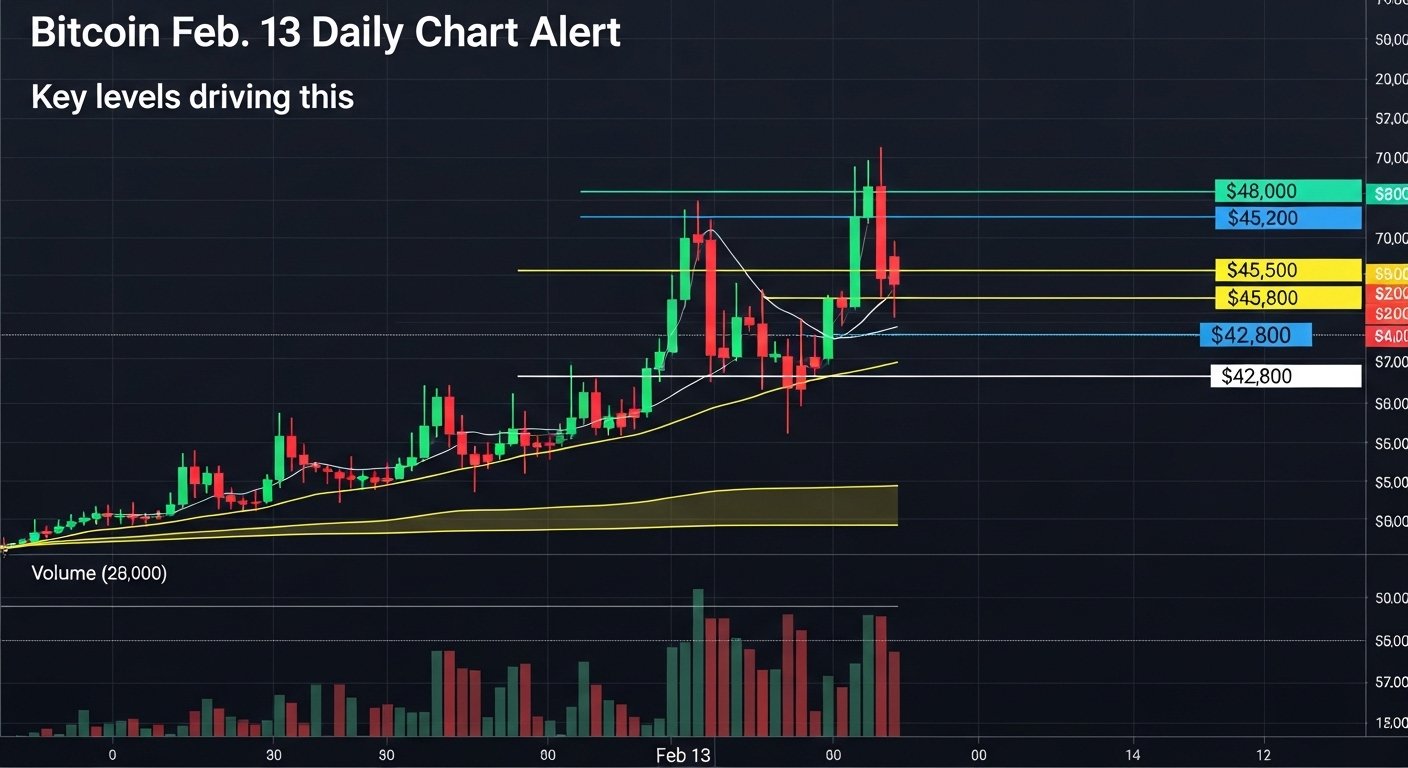
When Bitcoin is compressing, levels matter more than almost anything else. A clear Bitcoin Feb. 13 daily chart alert focuses on zones rather than single-point prices, because Bitcoin frequently pierces a level briefly before closing back above or below it. Daily closes are often more meaningful than intraday spikes. There are three critical level categories worth tracking: near-term support, overhead resistance, and the “line in the sand” that changes sentiment quickly.
The near-term support zone: Where buyers must defend
The support zone is the area where buyers have repeatedly stepped in and prevented a deeper slide. If Bitcoin continues to print daily closes that hold above this zone, it suggests demand is absorbing selling pressure. This is not automatically bullish, but it reduces the probability of immediate downside acceleration.
In practical terms, the biggest clue is candle behavior at the support zone. If daily candles show long lower wicks and close well above the lows, that indicates buying interest and rejection of lower prices. If candles close near the low of the day and rebounds are weak, it implies the support zone is fragile. For this Bitcoin Feb. 13 daily chart alert, support strength is about how price responds, not just where it touches.
The overhead resistance zone: Where sellers keep stepping in
Resistance is the zone where rallies have been capped. It’s also where many traders place sell orders, take profit targets, and short entries. If Bitcoin repeatedly fails at the same resistance area, the market learns that supply is waiting there. That can eventually lead to a breakdown if buyers lose confidence.
However, resistance also acts as a trigger for momentum. A decisive daily close above resistance—especially if followed by another close that holds the breakout—can shift the market quickly from cautious to aggressive. When that happens, the same resistance zone often flips into support, and that flip becomes confirmation for bullish continuation. In this Bitcoin Feb. 13 daily chart alert, the resistance flip is one of the most important signals to watch.
The line in the sand: The level that changes the narrative
The “line in the sand” is typically a major swing low, a prior consolidation floor, or a zone where a previous selloff accelerated. If Bitcoin breaks that level with a strong daily close and follow-through selling, sentiment can shift fast. Traders who were waiting for confirmation to sell get their signal. Longs who were hoping for support to hold get forced out. That combination can create a sharper move.
On the other hand, if Bitcoin tests the line in the sand and holds, it can become a foundation for a larger base. This is why a Bitcoin Feb. 13 daily chart alert should never treat one dip as a breakdown without confirmation. Bitcoin loves to hunt liquidity and then reverse.
Volatility is building: Why a bigger price move may be near
A major reason this Bitcoin Feb. 13 daily chart alert exists is the relationship between consolidation and volatility. When Bitcoin trades in a narrowing range, it often produces a sense of boredom. But boredom in markets can be dangerous, because it encourages traders to over-leverage or force trades. Then, when volatility returns, those traders get punished.
Volatility expansion tends to happen when price breaks out of a range and triggers a chain reaction. That reaction can include breakout orders, stop losses, liquidations, and algorithmic momentum flows. Bitcoin is known for these rapid bursts. When the daily chart compresses, it’s often hinting that the next burst could be larger than usual.
Another reason volatility matters is that the daily chart reflects broader participation. Intraday moves can be driven by short-term traders. Daily moves often reflect more meaningful positioning changes, including swing traders and larger market participants. If Bitcoin starts printing bigger daily candles after compression, it’s a strong sign that the market is shifting gears.
How volatility expansion usually unfolds
Volatility expansion commonly begins with one dominant daily candle. In a bullish expansion, you’ll often see a candle that closes near the high with limited upper wick, implying buyers controlled the session. In a bearish expansion, you’ll often see a candle that closes near the low with limited lower wick, implying sellers controlled the session.
But the next day is crucial. Many fake breakouts happen when price surges, triggers stop orders, and then collapses back into the range. A true breakout often holds above the broken level and shows follow-through. That’s why the best Bitcoin Feb. 13 daily chart alert approach is to watch the breakout, then watch the confirmation.
Reading the daily candles: What the chart is “saying” beyond indicators
Indicators can help, but daily candlesticks often speak more directly. A strong Bitcoin Feb. 13 daily chart alert focuses on candle anatomy: body size, wick length, close position, and the relationship of each candle to recent highs and lows.
If Bitcoin is printing repeated indecision candles with long wicks on both sides, it suggests uncertainty and two-sided trading. That can happen right before a major move, because the market is probing for liquidity and testing the conviction of both sides.
If Bitcoin is printing tighter candles with consistent higher lows, it suggests gradual accumulation. If Bitcoin is printing lower highs with weak closes, it suggests gradual distribution. These patterns aren’t guarantees, but they help shape probabilities.
Bullish candle behavior to watch
In a bullish setup, you typically want to see Bitcoin defend support and gradually push into resistance with stronger closes. A key bullish clue is when pullbacks become shallower. Another clue is when resistance gets tested multiple times. Each test can weaken the selling wall, especially if sellers fail to push price meaningfully lower afterward.
For this Bitcoin Feb. 13 daily chart alert, bullish confirmation often looks like a breakout close above resistance followed by a calm retest that holds.
Bearish candle behavior to watch
In a bearish setup, you often see weak bounces that fail below resistance, followed by renewed selling pressure. Another clue is when support gets tested repeatedly and rebounds become smaller. This suggests buyers are losing strength.
Bearish confirmation in a Bitcoin Feb. 13 daily chart alert often looks like a daily close below support followed by a failed attempt to reclaim that level. That failed reclaim is where many breakdowns accelerate.
LSI keywords and related phrases that matter for search and context
This Bitcoin Feb. 13 daily chart alert naturally connects to several related concepts that traders search for and use daily. BTC price prediction content often misses the point by pretending certainty, but a better approach is to focus on support and resistance, trend reversal signals, breakout confirmation, bearish breakdown risk, and volatility expansion. These phrases matter because they describe what traders are actually watching on the chart.
You’ll also see traders discussing daily timeframe analysis, candlestick patterns, price action, market structure, and liquidity zones. These are not buzzwords when used correctly. They are frameworks for interpreting what Bitcoin is doing without forcing an outcome.
The most important idea is to keep analysis grounded. The chart can tell you where the market is likely to react. It can’t guarantee where the market will go. That is why this Bitcoin Feb. 13 daily chart alert emphasizes confirmation and structure rather than sensational predictions.
What comes next: Scenarios for the next major BTC move
A complete Bitcoin Feb. 13 daily chart alert prepares you for multiple outcomes. The market will choose one, but you should be ready for all.
Bullish scenario: Breakout and continuation
In the bullish scenario, Bitcoin breaks above resistance with a strong daily close, then holds above it. This can shift sentiment quickly. Traders who were waiting for confirmation enter. Shorts cover. Momentum increases. If Bitcoin then retests the breakout level and holds, that retest becomes a higher-confidence entry zone for many swing traders. The key is that the breakout should not instantly collapse back into the range. A bullish Bitcoin Feb. 13 daily chart alert signal is strongest when price breaks, holds, and trends.
Bearish scenario: Breakdown and acceleration
In the bearish scenario, Bitcoin breaks below support and closes decisively under it. The next day fails to reclaim the broken level. This can trigger more selling, especially if many traders were using that support as a stop reference. Bitcoin breakdowns can be sharp due to liquidations. That’s why bearish confirmation matters so much. This Bitcoin Feb. 13 daily chart alert approach avoids reacting to a brief dip and instead watches for a decisive close and follow-through.
Sideways scenario: Range continues longer than expected
Sometimes Bitcoin stays in a range longer than traders expect. That can produce whipsaws and false signals. If this happens, the best approach is often to respect the range boundaries and avoid the middle. The middle zone is where many traders get chopped up and lose money without gaining insight. Even in a sideways scenario, the message of this Bitcoin Feb. 13 daily chart alert remains relevant: compression still tends to lead to expansion. The question is whether the expansion happens tomorrow or after more consolidation.
Risk management: The difference between a trade and a trap
The strongest Bitcoin Feb. 13 daily chart alert is incomplete without risk management. Bitcoin can move quickly, and the daily chart can shift sentiment in a single candle. Risk management is what keeps a trader alive when the chart does something unexpected.
Risk management can be as simple as respecting invalidation. If you’re bullish, you define where you’re wrong and size accordingly. If you’re bearish, you do the same. It also means avoiding emotional entries after a big candle prints. Chasing volatility is one of the most common ways traders turn a good idea into a bad trade.
If the chart is truly signaling a bigger move on the horizon, then your main job is not to guess direction perfectly. Your job is to avoid being forced out by noise and to participate only when the market shows confirmation.
Conclusion
This Bitcoin Feb. 13 daily chart alert highlights a classic setup: Bitcoin is compressing on the daily timeframe near key support and resistance zones, and that compression often precedes a stronger price expansion. The direction is not guaranteed, but the structure suggests the market is approaching a decision point.
If Bitcoin breaks above resistance and holds, the bullish case strengthens and a larger upside continuation becomes more likely. If Bitcoin breaks below support and fails to reclaim, the bearish case strengthens and downside acceleration becomes more likely. If Bitcoin stays range-bound, patience becomes the edge, because the eventual breakout or breakdown may be even more meaningful after extended consolidation.
Stay focused on daily closes, watch level behavior, and treat volatility as a warning that the market can change pace quickly. That is the core value of this Bitcoin Feb. 13 daily chart alert—it helps you see the setup before the move arrives.
FAQs
Q: What does a Bitcoin daily chart alert actually tell you?
A Bitcoin daily chart alert highlights important daily timeframe signals like consolidation, trend shifts, and key support and resistance zones. It helps traders focus on structure rather than intraday noise.
Q: Why is the Bitcoin Feb. 13 daily chart alert emphasizing a bigger move?
Because Bitcoin is compressing into a tighter daily range. When Bitcoin compresses, it often precedes a volatility expansion that produces a larger-than-usual move.
Q: What confirms a bullish breakout on the daily chart?
A strong bullish confirmation is a decisive daily close above resistance followed by follow-through or a successful retest where the old resistance holds as new support.
Q: What confirms a bearish breakdown on the daily chart?
A strong bearish confirmation is a decisive daily close below support followed by a failed reclaim attempt, where price returns to the level and gets rejected.
Q: How can I avoid false breakouts and whipsaws?
Focus on daily closes instead of intraday spikes, wait for confirmation, and avoid trading in the middle of the range. Use clear invalidation levels and proper position sizing.
See More: Buy Bitcoin at Best Available Price Smart, Secure BTC Guide Online