Blockchain Integration Services for Startups Guide
blockchain technology integration services for startups—secure smart contracts, dApps, tokenization, and seamless system integration.


Blockchain technology integration services for startups have become a serious competitive advantage, not just a trendy add-on. When you integrate blockchain the right way, you unlock transparent transactions, tamper-resistant records, programmable agreements, and new revenue models that traditional systems struggle to support. The catch is that blockchain isn’t “plug and play.” You need a strategy that fits your product, your compliance reality, and your users’ expectations. This guide breaks down what blockchain technology integration services for startups actually include, where they create real value, how to choose the right approach, and how to avoid expensive mistakes while building something scalable.
What Blockchain Technology Integration Services for Startups Actually Mean
When people hear “blockchain,” they often think of coins and speculation. Startups, however, care about outcomes: faster settlement, better auditability, stronger security, and new ways to coordinate incentives. Blockchain technology integration services for startups refer to the end-to-end work required to connect blockchain capabilities to a real product and a real business process. This can include blockchain consulting, requirements discovery, solution architecture, and selecting the right chain.
It often continues with smart contract development, building dApps, integrating wallets and identity, connecting on-chain events to off-chain systems, and setting up monitoring, testing, and incident response. In simple terms, integration services help you move from “we want blockchain” to “our users can safely use it in production.” The best integrations don’t force blockchain into everything. They use blockchain where it reduces friction or increases trust, and they keep the rest of the stack simple. That balanced approach is what separates a startup that ships value from one that ships complexity.
Why Startups Choose Blockchain Integration Instead of Building Everything From Scratch
A common early-stage trap is trying to build a blockchain stack with a small team while also shipping core product features. Even if you have great engineers, blockchain introduces extra layers: consensus rules, gas costs, key management, signing flows, chain reorganizations, and security assumptions that don’t exist in typical web apps. That’s why blockchain technology integration services for startups are usually about speed plus safety.
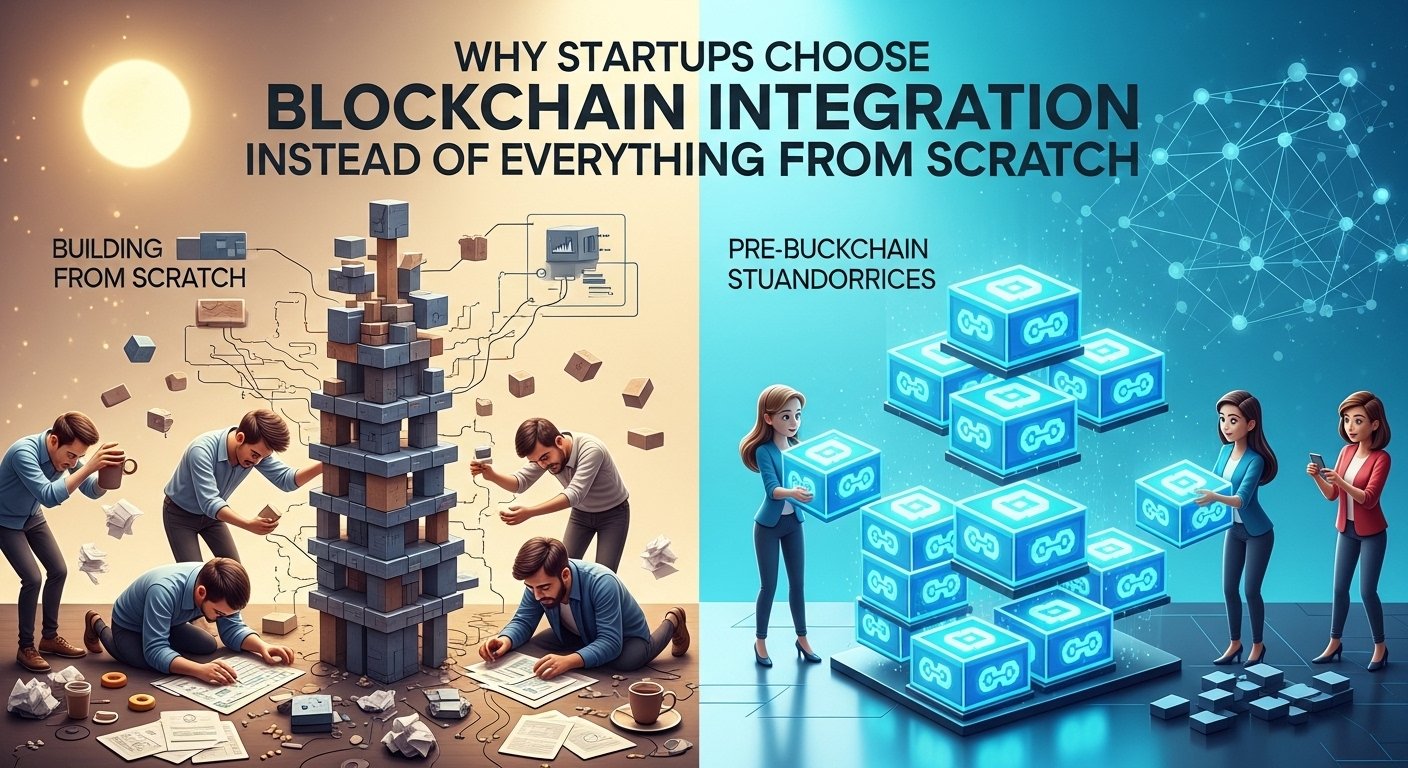
You accelerate development using proven patterns, audited libraries, and mature toolchains, while avoiding the hidden costs of security failures. In blockchain, one bug can be irreversible. A standard “patch later” mindset can become an existential risk if funds or sensitive records are involved. Integration services also help startups stay flexible. Many products need multi-chain options, upgrades, and compliance considerations. A good integration plan keeps you from locking into a path that limits future pivots.
Core Components of Blockchain Technology Integration Services for Startups
Most successful blockchain projects follow a predictable set of building blocks. Blockchain technology integration services for startups typically cover several of these areas, depending on your product.
Discovery, Use-Case Validation, and Blockchain Fit
Not every problem needs blockchain. Integration begins by mapping your trust gaps: Who needs to trust whom? Where do disputes happen? Where do audits matter? If your use case depends on shared truth across parties, durable audit trails, or automated settlement, blockchain can be a strong fit. This stage often includes a lightweight proof-of-concept plan, cost modeling, and a decision on whether you need a public chain, a permissioned setup, or a hybrid design.
Architecture and Chain Selection
Choosing between Ethereum L2s, sidechains, Solana, or permissioned frameworks depends on your requirements for security, fees, throughput, decentralization, and ecosystem compatibility. A strong architecture also defines what must live on-chain versus off-chain, which is critical for performance and cost. This is where web3 development services and blockchain consulting services bring clarity and guardrails.
Smart Contract Development and Testing
If your product uses tokens, escrow, automated payouts, or governance, you’ll likely need smart contract development. The real work isn’t just writing contracts—it’s writing contracts that can’t be exploited, that handle edge cases, and that remain maintainable. Testing should include unit tests, integration tests, fuzzing, and simulation of attack scenarios. Security reviews and audits matter because contract mistakes can be permanent.
Wallet, Identity, and Authentication Integration
User experience often makes or breaks adoption. Integration services commonly include wallet flows, signing UX, recovery strategies, and optional custodial or MPC approaches. If your startup needs compliance, KYC-friendly identity design can matter as much as the code. Here, crypto wallet integration and web3 authentication become essential LSI topics closely tied to outcomes.
Off-Chain Systems and API Integration
Real products connect to CRMs, ERPs, payment processors, analytics, and internal databases. Blockchain integration means you’ll need reliable bridges between on-chain events and off-chain actions. That typically includes indexing, event listeners, message queues, webhooks, and a clean API strategy. This part is often underestimated, yet it’s where production reliability is earned.
Infrastructure, DevOps, and Monitoring
You’ll need node access, RPC reliability, load handling, and monitoring for failures, latency spikes, and abnormal contract behavior. Integration services often include a DevOps setup for deployments, secrets handling, rate-limit strategies, and observability dashboards. Without this, even a well-written dApp can feel unreliable.
Where Blockchain Integration Creates Real Value for Startups
Startups win by solving a painful problem better than incumbents. Blockchain is valuable when it removes a trust bottleneck or creates a new coordination model. Here are the high-impact areas where blockchain technology integration services for startups commonly deliver returns. In fintech, blockchain can enable near-instant settlement, transparent ledgers, programmable escrow, and cross-border transfers. When combined with strong compliance design, it can reduce reconciliation costs and speed up partner onboarding.
In supply chain and manufacturing, blockchain helps create traceability and verifiable provenance. The value isn’t “put everything on-chain.” The value is being able to prove origin, handling steps, and custody changes in a way that multiple parties accept. In healthcare and identity, blockchain can support verifiable credentials and tamper-resistant records, while keeping sensitive data off-chain. Done properly, this improves auditability without leaking private information. In gaming, NFTs and tokens can enable user-owned assets, open marketplaces, and creator economies. The integration challenge is keeping gameplay smooth while handling wallet flows and network fees.
In SaaS, blockchain can add audit trails, licensing enforcement, and usage proofs across multiple organizations, which is especially powerful when customers demand transparency. Across these verticals, the consistent thread is trust at scale. If you’re building a product where multiple parties interact and disputes are costly, blockchain technology integration services for startups can convert complexity into confidence.
Popular Startup Use Cases Related to Blockchain Technology Integration Services for Startups
Startups searching on Google often look for proven “first-page” use cases before they commit. The most common high-intent topics include smart contract development services, dApp development, tokenization platform development, NFT marketplace development, DeFi development, web3 consulting, and enterprise blockchain integration. The key is matching the use case to your business model.
Tokenization is popular because it can turn a product ecosystem into a network. That might mean tokenized loyalty points, fractional ownership, or access rights. But tokenization also raises questions about economics, governance, and compliance. Integration services help you design token logic responsibly, not just implement it. NFT marketplaces are another common search. The integration challenge here is metadata integrity, royalties logic, marketplace security, and smooth onboarding for non-crypto users.
Good integration often means supporting credit card on-ramps, custodial options, and gas abstraction. DeFi is high-risk, high-reward. You need robust contract design, deep testing, and clear risk controls. Integration services matter because DeFi failures are public, fast, and often irreversible. Enterprise integration appears when startups sell to large organizations. The startup may need permissioned access, audit logs, and internal system compatibility. This is where enterprise blockchain solutions and pragmatic architecture shine.
How to Plan a Blockchain Integration Roadmap Without Losing Momentum
A strong roadmap keeps you from overbuilding. The best blockchain technology integration services for startups typically structure delivery in phases so you ship value early while managing risk. Phase one focuses on validation. You identify one or two high-impact workflows, define on-chain and off-chain boundaries, and build a lean proof of value. This phase aims to answer, “Will users actually benefit from blockchain here?” without building a full ecosystem prematurely.

Phase two moves into production readiness. You finalize architecture, implement security controls, formalize key management, and create a stable integration pipeline. You also establish monitoring, analytics, and incident procedures. Phase three focuses on scale. This includes performance improvements, multi-chain or L2 adoption, cost optimizations, and growth features like referral incentives, partner APIs, or advanced governance. The biggest roadmap mistake is doing “blockchain everything” at once. Integration is not a single feature. It’s a system change. The fastest teams keep scope tight and ship iteratively.
Choosing the Right Provider for Blockchain Technology Integration Services for Startups
Selecting a partner is not just a procurement decision—it’s a product decision. You want a team that can ship, secure, and support your system under real-world conditions. When evaluating blockchain technology integration services for startups, pay attention to how the provider thinks, not just what they claim. A strong provider will challenge your assumptions and help you avoid unnecessary on-chain logic. They will also talk clearly about security, audits, upgrade patterns, and operational risk. If every conversation sounds like marketing, that’s a warning sign.
Look for evidence of production experience: incident handling, monitoring practices, and post-launch support. Blockchain failures rarely happen during demos; they happen during peak load, volatile gas markets, or adversarial conditions. Also, watch for UX maturity. Startups need adoption, and adoption depends on clarity. Great integration services include wallet UX, signing clarity, and recovery strategies that don’t confuse users. Finally, ensure your partner can support your stack. Many startups need smart contract development, dApp development, backend integration, and DevOps together. Fragmented responsibility often leads to gaps.
Security, Compliance, and Risk: The Non-Negotiables
Security is not a “later” item in blockchain. If funds, assets, or critical records are involved, you need defense-in-depth from day one. Blockchain technology integration services for startups should cover secure coding, threat modeling, and audit readiness. Smart contract security includes access control, reentrancy protection, overflow safety, oracle assumptions, and upgrade safety. It also includes careful handling of admin keys and emergency procedures. Many startups fail here because they treat keys like normal credentials. Key compromise in blockchain can be catastrophic.
Compliance depends on your domain and geography, but common concerns include data privacy, consumer protection, and financial rules. A practical approach keeps sensitive data off-chain, uses encryption, and builds audit-friendly trails without exposing private information publicly. Risk management also includes operational details: what happens if an RPC provider goes down, if an indexer lags, if transaction fees spike, or if a chain experiences instability. Mature integration designs include graceful fallbacks and transparent user messaging.
Tech Stack Decisions That Matter for Startups
The best stack is the one your team can maintain. Blockchain technology integration services for startups usually include guidance on the stack that aligns with your hiring plans and product timeline. On-chain, you may use Solidity-based ecosystems for broad tooling and talent availability, or alternative ecosystems when performance or specific features matter. Off-chain, you’ll likely keep a familiar backend with well-defined boundaries and a robust event ingestion system.
Indexing and data access often require specialized tools or custom pipelines. Startups that ignore this end up with slow dashboards and unreliable user experiences. A clean indexing plan helps you serve real-time states, histories, and analytics without hammering RPC endpoints. For scaling, L2s and rollups can reduce fees, but they also introduce bridging considerations. Integration services help you design a user path that doesn’t feel like a maze.
Cost and Timeline: What to Expect Realistically
Costs vary widely, but the real drivers are scope, security requirements, and integration complexity. A basic blockchain feature can be relatively fast, while a full token economy with audited contracts and multi-system integration requires more planning. Timeline risk often comes from unclear requirements, late security reviews, and underestimating off-chain work.
One of the biggest benefits of blockchain technology integration services for startups is avoiding rework by making architecture decisions early, especially around on-chain boundaries, key management, and upgrade strategies. If you want predictable delivery, define success metrics up front. For example, you might measure transaction confirmation reliability, onboarding completion rates, cost per transaction, or reduction in reconciliation time. Clear metrics keep the work grounded in business outcomes, not hype.
Real-World Example: A Startup Integration Story Without the Buzzwords
Imagine a B2B startup that manages supplier compliance documents across multiple vendors. The core pain is trust: vendors upload files, buyers audit them, disputes happen when documents change, and different departments struggle to agree on the latest version. The startup doesn’t need every file on-chain. Instead, the integration places cryptographic proofs and time-stamped records on-chain, while storing documents securely off-chain.
With blockchain technology integration services for startups, the team builds smart contracts that record document hashes and approval events, integrates identity so authorized parties can attest to changes, and connects on-chain events to the SaaS dashboard. The result is a faster audit process, fewer disputes, and a premium feature that buyers gladly pay for because it reduces risk. That’s what good blockchain integration looks like: fewer arguments, cleaner audits, and better coordination—without turning your product into a crypto experiment.
FAQs
Q: Do startups need a token to use blockchain effectively?
No. Many high-value products use blockchain for audit trails, settlement, provenance, or credentials without issuing a token. A token can help if you need incentive alignment or ownership transfer, but it also introduces complexity and regulatory considerations. Integration services help you decide based on product value, not trends.
Q: Should we build on a public chain or a permissioned network?
Public chains offer strong transparency and network effects, while permissioned systems provide more control and privacy. Many startups use hybrid models: public for verification and settlement, private for sensitive operations. The best choice depends on your users, compliance needs, and cost tolerance.
Q: How do we keep user experience simple for non-crypto customers?
Focus on onboarding, wallet options, and clear signing prompts. Many startups use custodial or MPC-based approaches early, then add self-custody options for advanced users. Strong crypto wallet integration and thoughtful UX design are often more important than chain choice.
Q: What’s the biggest risk in blockchain integration?
Security and operational reliability. Smart contract bugs, key mismanagement, and fragile infrastructure can break trust instantly. That’s why blockchain technology integration services for startups should prioritize security reviews, monitoring, and production-grade processes.
Conclusion
Blockchain can be a growth engine when it solves a real trust problem, but it can become dead weight when it’s bolted on without a plan. The difference is integration quality: clear architecture, secure contracts, reliable infrastructure, and user-friendly flows. If you want to ship confidently and scale without surprises, invest in blockchain technology integration services for startups that prioritize business outcomes, security, and long-term maintainability. If you’re ready to design a practical roadmap, reduce risk, and launch a production-grade Web3 feature set, choose blockchain technology integration services for startups that can take you from strategy to secure deployment—and help you grow from MVP to market leader.