
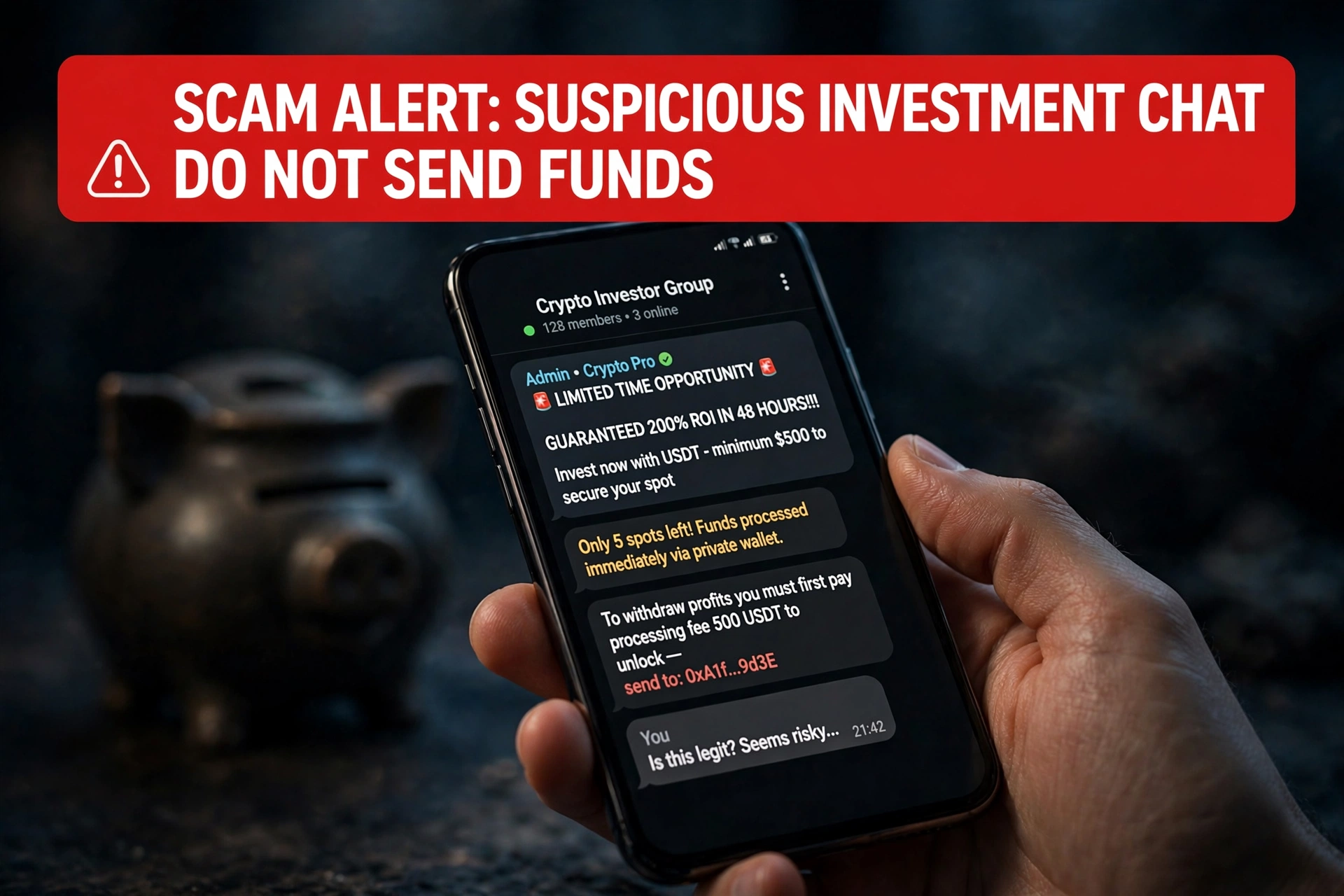
In September 2026, the U.S. Financial Crimes Enforcement Network flagged roughly $12.7 billion in suspicious activity tied to pig-butchering crypto investment scams. These frauds start with a friendly message or a fake romance and end with victims watching their life savings disappear into criminal wallets. Here is how large the threat has grown in 2026 — and the exact steps that keep you safe.
Key Takeaways
- FinCEN's September 3, 2026 alert (FIN-2026-Alert005) flagged about $12.7 billion in suspicious activity linked to pig-butchering and romance-baiting crypto investment scams, based on 33,904 Bank Secrecy Act reports filed by roughly 1,300 institutions between September 2023 and December 2025.
- The FBI reported roughly 61,000 IC3 complaints and over $1.6 billion in losses from scammers impersonating law enforcement and government officials between January 2025 and July 2026 (warning reported around September 22, 2026).
- The FCA, HMRC and the Metropolitan Police raided three London premises suspected of running illegal peer-to-peer crypto trading businesses on September 10 (FCA press release September 17, updated October 1) — and confirmed there are zero solely FCA-registered P2P crypto businesses in the UK.
- Southwark Crown Court granted confiscation orders totaling about £851,402 against Raymondip Bedi (£603,404.28) and Patrick Mavanga (£247,997.99) on September 28, 2026, over a £1.54 million fake crypto-investment cold-calling fraud that defrauded at least 65 investors; recovered funds are being returned to victims.
- A U.S. jury convicted Jonathan Spalletta, known as "Cthulhon," of computer fraud and money laundering for the two 2021 Uranium Finance hacks totaling about $54.7 million; he laundered proceeds through Tornado Cash and about $31 million was seized in February 2025 (DOJ press release October 7, 2026).
What Is a Pig Butchering Scam?
The name is grim, but it describes the method exactly. Scammers "fatten up" a victim — usually through a wrong-number text, a dating app, or social media — building trust over weeks or months. Then comes the "slaughter": the new "friend" introduces a supposedly lucrative crypto investment opportunity, directs the victim to a professional-looking trading platform, and encourages ever-larger deposits. The platform shows fake profits to keep the victim adding funds. The moment the victim tries to withdraw, the money is gone.
FinCEN's September 2026 alert connects much of this activity to organized criminal compounds in Southeast Asia, specifically naming Cambodia, Laos and Myanmar as hubs. One important nuance: FinCEN's $12.7 billion figure represents flagged suspicious activity, not confirmed victim losses. Still, the scale is staggering — it was built from nearly 34,000 suspicious-activity reports across the U.S. financial system.
The Record Scale of Crypto Fraud in 2026
FinCEN's $12.7 Billion Flag
The FIN-2026-Alert005 advisory, issued September 3, 2026, is one of the largest fraud alerts in FinCEN's history. Drawing on Bank Secrecy Act filings from roughly 1,300 institutions covering September 2023 to December 2025, it mapped how pig-butchering and romance-baiting schemes move money through the financial system. The alert was aimed at banks and crypto firms, warning them what the red flags look like — because these scams almost always pass through legitimate-looking accounts before the crypto disappears.
The FBI's 2025 Numbers Tell the Same Story
The FBI's IC3 2025 report, published in April 2026, recorded 181,565 crypto-related complaints and a record $11.4 billion in crypto-fraud losses — up 22% year over year. Investment scams alone accounted for $7.2 billion of that total. Americans aged 60 and older were hit hardest, losing $4.4 billion. These are confirmed reported losses, and they show the same trend as FinCEN's data: crypto investment fraud is not shrinking, it is accelerating.
Scammers Are Now Impersonating the Police
In a warning reported around September 22, 2026, the FBI described a surge of fraudsters impersonating U.S. and foreign law enforcement officers and government officials. Between January 2025 and July 2026, this single tactic generated roughly 61,000 IC3 complaints and more than $1.6 billion in losses.
The playbook is psychological: the caller claims you are under investigation or that your identity was used in a crime, then demands immediate payment — in cryptocurrency, prepaid cards, wire transfers, courier cash, or cash stuffed into crypto kiosks. Victims are pressured to stay silent and not tell family or banks. Remember this clearly: no legitimate law enforcement agency or government official will ever demand payment in crypto, gift cards, or cash through a kiosk.
Authorities Are Fighting Back
London Raids Target Illegal P2P Crypto Trading
On September 10, the FCA joined HMRC and the Metropolitan Police in raiding three London premises suspected of operating illegal peer-to-peer crypto trading businesses, issuing cease-and-desist letters. In its September 17 press release (updated October 1), the FCA confirmed a striking fact: there are zero solely FCA-registered peer-to-peer crypto businesses in the UK. If someone in Britain offers you P2P crypto trading services, that alone is a red flag worth checking against the FCA register.
£851,402 Confiscated From Cold-Calling Fraudsters
On September 28, 2026, Southwark Crown Court granted the FCA confiscation orders against Raymondip Bedi (£603,404.28) and Patrick Mavanga (£247,997.99) — about £851,402 combined. The pair ran a £1.54 million fake crypto-investment fraud through cold calling, using entities called CCX Capital and Astaria Group LLP, defrauding at least 65 investors. The confiscated money is being returned to victims — a reminder that reporting fraud genuinely helps.
The Uranium Finance Hacker Convicted
On October 7, 2026, the U.S. Department of Justice announced that a federal jury had convicted Jonathan Spalletta — who operated as "Cthulhon" — of computer fraud and money laundering for the two 2021 hacks of Uranium Finance, which drained about $54.7 million. Spalletta laundered the proceeds through the Tornado Cash mixer, and investigators seized roughly $31 million in February 2025. Even sophisticated DeFi exploits are being prosecuted years later.
How to Protect Yourself From Crypto Scams
- Verify before you send. Check firms against official registries — the FCA register in the UK, or state and federal regulators in the U.S. Zero registered P2P crypto businesses exist in the UK, so treat any such offer as suspect.
- Never trust unsolicited investment contacts. Cold calls, wrong-number texts, and new online romances that pivot to "amazing crypto returns" are the classic pig-butchering setup.
- Know that officials never demand crypto. Police, tax agencies and courts do not take payment in cryptocurrency, prepaid cards, wires to strangers, or cash into crypto kiosks.
- Inspect the platform. Fake investment sites look polished but have no verifiable company behind them, pressure you to deposit more, and block withdrawals with "tax" or "fee" demands.
- Slow down and talk to someone. Scammers manufacture urgency and secrecy. A trusted friend, family member, or your bank will spot what panic hides.
- Never share private keys or seed phrases. No legitimate service needs them — ever.
- Report it. In the U.S., file with the FBI's IC3; in the UK, contact Action Fraud and the FCA. Confiscation cases like the Bedi and Mavanga one show recovered funds can reach victims.
Frequently Asked Questions
What is a pig butchering scam?
It is a long-con fraud where scammers build a fake friendship or romance, then lure the victim into a bogus crypto investment platform. Deposits are real; the "profits" are fake, and withdrawals are impossible.
How much have pig-butchering scams actually cost?
FinCEN flagged about $12.7 billion in suspicious activity tied to these scams in its September 2026 alert — that is flagged activity, not confirmed losses. Separately, the FBI's April 2026 IC3 report confirmed a record $11.4 billion in total crypto-fraud losses for 2025.
Will the police ever ask me to pay in cryptocurrency?
No. Legitimate law enforcement and government agencies never demand payment in crypto, prepaid cards, wire transfers, or cash deposited into crypto kiosks. Anyone who does is a scammer.
I already sent crypto to a scammer. What should I do now?
Stop sending money immediately, save every message, screenshot and transaction record, then report to the FBI's IC3 (U.S.) or Action Fraud and the FCA (UK). Be wary of "recovery services" that contact you afterward — they are usually a second scam.