Ethereum Price Forecast: ETH at $2,106 Faces Risk of Drop Toward $1,800
Ethereum (ETH), the world’s second-largest cryptocurrency by market capitalization, is facing renewed bearish pressure as market sentiment weakens and key technical levels fail to hold.


The latest Ethereum price forecast suggests that traders should closely monitor critical support zones, macroeconomic developments, and institutional inflows. While long-term optimism around Ethereum’s ecosystem remains intact due to its role in decentralized finance (DeFi), smart contracts, and staking, short-term market conditions appear significantly more fragile.
Ethereum Price Drops Below Key Technical Support
Ethereum’s recent decline accelerated after it failed to maintain support above the 100-day moving average near $2,150. Technical analysts view this breakdown as a bearish signal because the moving average had served as a major support level during previous corrections. Once this support broke, ETH slipped closer to the psychologically important $2,000 mark, raising fears of further downside pressure.
At the time of analysis, Ethereum was trading near $2,106, reflecting a weekly decline of roughly 9%. Compared to previous highs, ETH has also remained significantly below its all-time peak near $4,950, highlighting the scale of its correction in the broader crypto market cycle.
Market technicians believe that if Ethereum fails to hold above the $2,000 level, the next major support area could emerge around $1,914 before extending toward the widely discussed $1,800 target. This level has become an important reference point for traders because it aligns with historical demand zones where buyers previously entered the market.
Why Ethereum Is Under Pressure
Several factors are contributing to Ethereum’s current weakness. One of the most significant concerns is declining institutional demand. Recent reports indicate that spot Ethereum exchange-traded funds (ETFs) experienced hundreds of millions of dollars in outflows during the past week, signaling reduced investor confidence amid heightened market uncertainty. Institutional investors often play a major role in determining short-term price momentum, making ETF activity an important metric for market participants.
Another challenge comes from the broader macroeconomic environment. Rising treasury yields, inflation concerns, and geopolitical uncertainty have reduced investor appetite for high-risk assets such as cryptocurrencies. As financial markets move into risk-off territory, digital assets including Ethereum have struggled to maintain bullish momentum. Analysts note that Ethereum tends to be more sensitive to changing liquidity conditions than Bitcoin because of its stronger connection to speculative market activity.
Ethereum’s network activity has also raised concerns. Transaction costs, commonly known as gas fees, have dropped substantially, reflecting lower blockchain activity. While cheaper fees may benefit users, they can negatively affect Ethereum’s token-burning mechanism, which historically supported ETH scarcity and price appreciation. Weak on-chain activity often signals reduced investor engagement and lower network demand.
Technical Analysis: Can ETH Hold $2,000?
From a technical perspective, Ethereum’s immediate future largely depends on whether the $2,000 support zone can withstand current selling pressure. Technical analysts are closely watching this psychological level because a breakdown below it could trigger additional liquidations and stop-loss selling from traders.
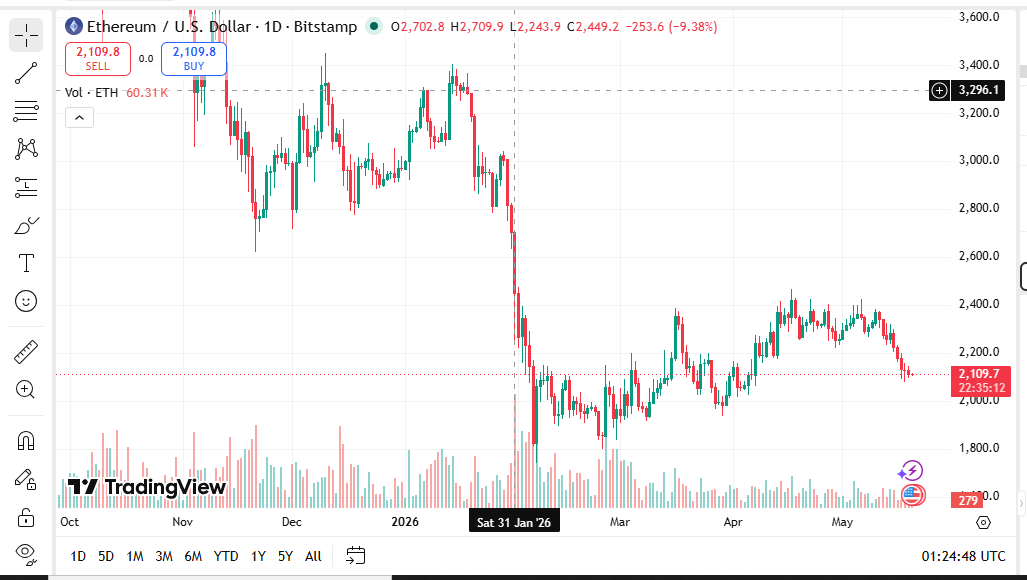
Short-term resistance currently sits between $2,150 and $2,200. Since Ethereum recently lost this range, any recovery attempts may face strong selling pressure from traders seeking to exit losing positions. Reclaiming this zone would be necessary to improve short-term sentiment and potentially reduce downside risks.
Indicators such as the Relative Strength Index (RSI) have also turned weaker, suggesting bearish momentum remains dominant. Additionally, Ethereum continues to underperform Bitcoin in relative strength metrics, reinforcing concerns that investors are shifting capital toward perceived safer crypto assets.
Some bearish forecasts even suggest that if broader market conditions deteriorate significantly, Ethereum could test deeper support levels near $1,500 or, in extreme scenarios, around $1,300. However, such outcomes would likely require a major macroeconomic shock or an extended crypto market downturn.
Long-Term Outlook for Ethereum
Despite short-term bearish signals, Ethereum’s long-term fundamentals remain relatively strong. Ethereum continues to dominate decentralized applications, non-fungible tokens (NFTs), decentralized finance protocols, and blockchain infrastructure development. Its transition to proof-of-stake and ongoing network upgrades have improved scalability and energy efficiency, making it a foundational platform in the crypto ecosystem.
Many analysts still maintain optimistic long-term forecasts for Ethereum, arguing that the current weakness could eventually become a buying opportunity for long-term investors. Historical market cycles suggest that Ethereum has experienced deep corrections before eventually recovering and reaching new highs during stronger market conditions.
Some industry observers believe institutional adoption may strengthen again over time, particularly if Ethereum ETFs regain inflows and broader regulatory clarity improves. Additionally, increasing stablecoin activity and Ethereum’s continued dominance in smart contracts may support future price recovery once macroeconomic conditions stabilize.
Investor Sentiment and Market Outlook
Current market sentiment surrounding Ethereum remains cautious. Fear-driven selling, declining momentum, and weak institutional flows have placed ETH in a vulnerable position. Traders are now focused on whether Ethereum can defend the $2,000 support level or whether sellers will push the price toward the next key target near $1,800.
At the same time, long-term investors continue monitoring Ethereum’s broader ecosystem growth rather than reacting solely to short-term volatility. Crypto markets have historically been cyclical, meaning periods of weakness are often followed by strong recoveries when market conditions improve.
Conclusion
Ethereum’s current price action reflects growing market uncertainty, with ETH trading near $2,106 and facing increased downside risk toward $1,800. A combination of technical weakness, ETF outflows, macroeconomic pressures, and lower network activity has contributed to bearish sentiment in the short term. The loss of key support around $2,150 has intensified concerns that Ethereum could struggle to maintain its footing if the $2,000 psychological barrier fails.
However, Ethereum’s long-term outlook remains supported by strong ecosystem fundamentals, smart contract leadership, and continued blockchain innovation. While traders may remain cautious in the coming weeks, long-term investors still see Ethereum as one of the most important assets in the cryptocurrency market. Whether ETH falls to $1,800 or stages a recovery may depend largely on broader market conditions and renewed investor confidence.